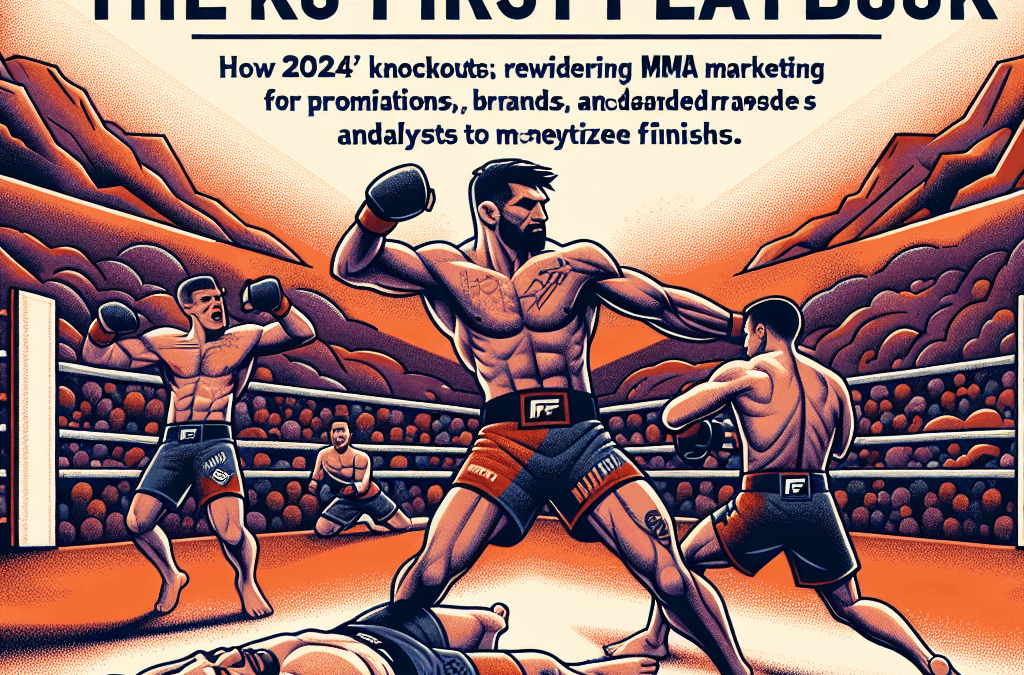
Introduction — Why 2024 Was the Year of the Finish
2024 rewired how the MMA business thinks about value. From Ilia Topuria’s title-seizing knockout of Alexander Volkanovski at UFC 298 to Max Holloway’s buzzer-beating walk-off over Justin Gaethje and Alex Pereira’s first-round KO at UFC 300, the sport’s defining moments were instant, visual, and endlessly shareable. Robert Whittaker’s statement knockout in the UFC’s Saudi Arabia debut and PFL’s Saudi-backed supercards further entrenched the Middle East as an accelerant for global growth.
These finishes are not just highlight reels; they’re commercial catalysts. KOs are the sport’s most exportable IP — universally understood, algorithm friendly, and unbeatable in short-form formats. This piece is a practical playbook for promotions, brands, and analysts who want to turn fight-ending moments into sustained revenue, fandom growth, and sharper fighter analysis.
Section I — The Data Case: Why KOs Drive Reach, Revenue and Ratings
UFC stats and broader MMA performance metrics show that finishes accelerate attention spikes and prolong engagement windows. A single viral KO can generate the equivalent of multiple mid-card bouts in earned media, boosted social impressions, and secondary merchandising sales.
Key performance patterns to watch (and measure):
- Immediate spike magnitude: seconds-to-minutes view growth on platforms after a finish.
- Half-life extension: how long highlight clips and reaction videos remain in feed circulation compared to decision fights.
- Cross-market lift: translation of a finish into non-core markets (e.g., Spanish or Arabic-speaking corridors after Topuria’s and UFC’s Saudi showcase).
- Betting and wagering interest: live-betting volume and post-event prop activity following dramatic KOs.
For analysts building fighter power rankings and predictive models, including knockout propensity and past MMA knockout records as weighted inputs improves predictive accuracy. KOs are simultaneously an output (result) and a predictive feature (fighter style + striking metrics + finishing rate).
Section II — The KO-First Playbook (How to Operate in Real Time)
If the finish is the product, distribution and commercialization are the factory. Here’s a seven-point playbook that turns knockouts into multi-format brand assets — fast.
- Moment-mining in real time — Pre-build editable templates (vertical, square, broadcast-safe) for KO cuts, alt-angle slow-mos, and fighter POV reaction stitches. Target a 5-minute turnaround for the first cut to own the narrative window.
- Geo-optimized distribution — Simul-publish KO cuts with localized captions/hashtags across EN/ES/PT/AR and route to time-zone matched spikes (Americas, EMEA, APAC). A single KO reel should become four market-ready posts within 15 minutes.
- Rights-smart UGC — Greenlight creator remixes with trackable audio beds and subtle watermarking so creators amplify the asset without cannibalizing official channels. Provide B-roll and key timestamps to reduce friction for UGC creators.
- Commerce hooks — Drop-time merch (walkout kits, signed canvas fragments, limited KO posters) within 24 hours. Tie in small, timed paid boosts for conversion windows following the highlight spike.
- Betting and brand safety — Pair KO reels with compliant, age-gated odds content and a violence-context disclaimer to enable premium advertisers while protecting platform policies.
- Talent packaging — Build trailer arcs that label finishers (Topuria, Pereira, Holloway) as “must-watch” attractions, and support contenders with behind-the-scenes KO build-up content that emphasizes power and timing using UFC performance metrics.
- Regional tentpoles — Commit to at least one explosive, finish-forward card per quarter in emerging hubs (Gulf, Iberia, LatAm). Local tentpoles compound fandom and turn one-off finishes into sustained market penetration — as seen in MENA after the Riyadh showcase.
Section III — Tactical Execution: Production, Rights, and Measurement
Execution requires cross-functional discipline: production, legal, digital, sponsorship, and athlete relations. Practical steps:
- Multi-angle capture — Invest in additional cage- and crowd-facing cameras, helmet cams for slow-mos, and redundant capture to ensure multiple usable frames for creators and broadcasters.
- Biometric overlays — Use speed, impact-force, and strike-count overlays to enrich clips for hardcore fans and media packages. These numbers feed into deeper fighter analysis and offer new sponsorship inventory (e.g., performance sensors).
- Rights architecture — Build tiered licensing: official short-form, creator remix allowance, and paid archive access for documentary producers. Make it easy to re-license while tracking attribution and revenue.
- Measurement stack — Beyond views, track share density, creator multiplier, commerce conversion rate, and regional fan lift (new followers, geolocated searches). Tie KPIs back to PPV and merchandise margins to quantify ROI.
Analysts should fold these operational metrics into models of fighter valuation and all-time UFC records benchmarking. A fighter’s knockout ROI — incremental revenue attributable to their finishing style — is the new signal for negotiations and matchmaking leverage.
Section IV — What’s Next: Tech, Talent, and Market Moves
Expect heavier investment in multi-angle capture, biometric storytelling, and AI-assisted highlight personalization so fans see “their” version of the KO in minutes. Platforms will prioritize finish-first feeds: short-form reels with embedded contextual stats that satisfy both casual viewers and data-driven fans.
For brands and promotions, the forward play is clear:
- Architect around the finish, not just the event. Make the KO the asset that unlocks sponsorship tiers, retail drops, and content syndication.
- Develop regional content ops for non-English markets (Topuria’s Spanish/Georgian corridors are a blueprint) to convert viral moments into durable local fandom.
- Use the finish to upgrade predictive models — incorporate MMA striking trends, KO timelines, and situational pressure stats into UFC predictions and bettor-facing content to increase engagement.
Finally, for aspiring analysts and content creators: upgrade tooling around UFC stats, finishing rates, and impact metrics. A fight’s narrative is increasingly driven by measurable moments — the KO-first era rewards anyone who can quickly translate flash into context, and context into commerce.
Conclusion — Own the Moment, Own the Market
2024 proved that knockouts are more than fight outcomes — they’re the sport’s primary growth engine. Promotions that can capture, localize, license, and monetize finishes in real time will own the feed and the fandom. For brands and analysts, the imperative is simple: treat KOs as strategic assets. Build the operational playbook outlined here, measure the right KPIs, and you’ll not only predict fighter trajectories better — you’ll turn highlight moments into sustainable revenue.
Want a downloadable checklist version of this KO-First Playbook and a template pack for immediate deployment? Subscribe to our newsletter or follow our coverage for monthly playbook updates and deep dives on fighter power ranking methodology, MMA knockout records, and advanced fighter analysis.
Recent Comments